With increased profile, they hope for role to bridge cultural, social gaps, prepare for reunificationNorth
Korean defectors are emerging from the periphery to take center stage
in academic, political, religious and other spheres, hoping to lay the
groundwork for reunification.
Brushing aside lingering prejudices
against the defectors in South Korea, they have striven to carve out a
distinct role to raise the public understanding of the communist state
and bring about a change for the people struggling north of the border.
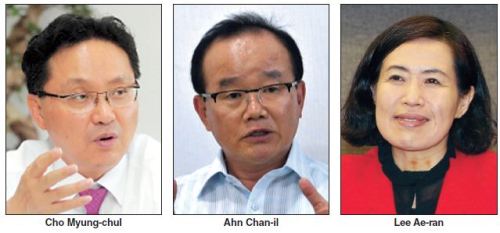
Among them is Cho Myung-chul who became the first defector elected to the National Assembly last week.
“My
heart is all aflutter as the very citizens here elected me to the
Assembly with many defectors pinning hopes on me. I feel humbled by all
that trust and will try to pay back while working harder with my
experience and knowledge,” he told The Korea Herald.
Before
taking the ruling party’s proportional representation seat, Cho, a
former economics professor at Pyongyang’s Kim Il-sung University, headed
the Education Center for Unification under the Unification Ministry for
nine months until March. He was the first defector to hold the
high-level government post.
Cho, who defected to the South in
1994, now dreams of an active legislative role to craft
“future-oriented, realistic policies” aimed at helping defectors better
adapt here and stopping human rights abuses in the repressive state. The
number of defectors was 23,513 as of March, according to government
data.
“We can first achieve reunification on a small scale by
helping the defectors settle here smoothly, develop their potential and
grow as successful citizens here. Through this process, we can achieve a
genuine one on a bigger scale,” he said.
“To this end, I will
work hard to enact laws to support their settlement and craft policies
concerning their medical care, housing, education and activities in
various sectors of society.”
Touching on the North, which has
missed out on decades of progress while holding onto its outmoded
governing system, Cho stressed the importance of change for its survival
in the competitive world.
“In the process of us pursuing
reunification, the North should actively seek change. Under the current
system, it cannot move forward when every country in the world
constantly strives to change,” he said.
“The North continues to
hold on to the past and refuses any change as it believes any change
could lead to the collapse of its regime.”
Another high-profile defector is Ahn Chan-il, director of the World North Korea Research Center.
He
is well-known for being the first defector to receive a doctorate in
the South. He defected here in 1979 at age 25, studied political science
at Seoul’s Korea University and earned his doctorate from Konkuk
University in 1997.
Since last year, he has run a private academy
to train young North Korean defectors to become leading members of
society here ― a mission that he believes is critical to raise those who
can help facilitate the reunification process.
“As uncertainty
deepens with the new leadership in Pyongyang, reunification could come
all of a sudden. For this, we should prepare sufficiently by raising
human resources who can successfully lead the preparation,” said Ahn.
“There
are some who gave up their studies and are wandering aimlessly. We can
make young defectors sort of successful models through training and
education, and that would give hope to others who can follow in their
footsteps.”
Ahn is also aspiring to enter politics to play a more
effective role in the country’s preparation for reunification. He now
serves as vice chairman of the Saenuri Party’s human rights panel.
“The
reason why I studied politics here is I had this hope to establish a
society just like South Korea in the North. That is why I now focus on
educating young students about unification and seek to become a
legislator myself,” he said.
“From a broader perspective, I hope
more defectors take a leading role in this society to facilitate the
reunification process and the efforts to improve humanitarian
conditions, given that the North is also defined as our territory in the
Constitution.”
Lee Ae-ran is another success story. She made
headlines in 2009 after she became the first female defector to receive a
doctorate in food and nutrition from Ewha Womans University.
Lee,
who defected to the South in 1997, currently leads the private North
Korean Traditional Food Institute where she gives job training to other
defectors and strives to spread Pyongyang’s food culture as a way to
bridge the yawning cultural gap between the two Koreas.
“There
are big gaps in social, cultural aspects, which spawned
misunderstandings and prejudices and a lack of communication between the
two sides. So, I have long thought of what I can do to help bridge
them,” said Lee.
“Through North Korean cuisine, I want to share
with South Koreans the way North Koreans live so that I can raise their
understanding of their northern brethren.”
She has also been at
the forefront of the campaign against the repatriation of North Korean
refugees held in China. Last month, she led a hunger strike for 18 days
in front of the Chinese Embassy, calling on Beijing to help save their
lives.
“I always feel sorry that I live a good life here in the
South while many in the North are suffering. I am not an activist or
anything, but I felt sad that North Korean issues are being politicized
here, which has made people here lose interest in them,” Lee said.
“We should think about the issues without any political, religious intentions.”
All
the high-profile defectors hoped that South Korean society could
embrace the defectors with a more mature perspective, rather than
thinking of them as a drain on taxpayers’ money.
“Some people
here believe the defectors are only burdensome, rather than looking at
their potential to help facilitate the reunification process. With a
little investment in them, we can rake in bigger gains later on,” said
Cho.
“We also have to think about the exclusive nature of our
culture that was reluctant to embrace not only defectors but also those
from multicultural families.”
By Song Sang-ho (sshluck@heraldm.com)


 Text
Text